Patchwork Rules, Real Consequences: How Micromobility Regulation Is Failing American Commuters
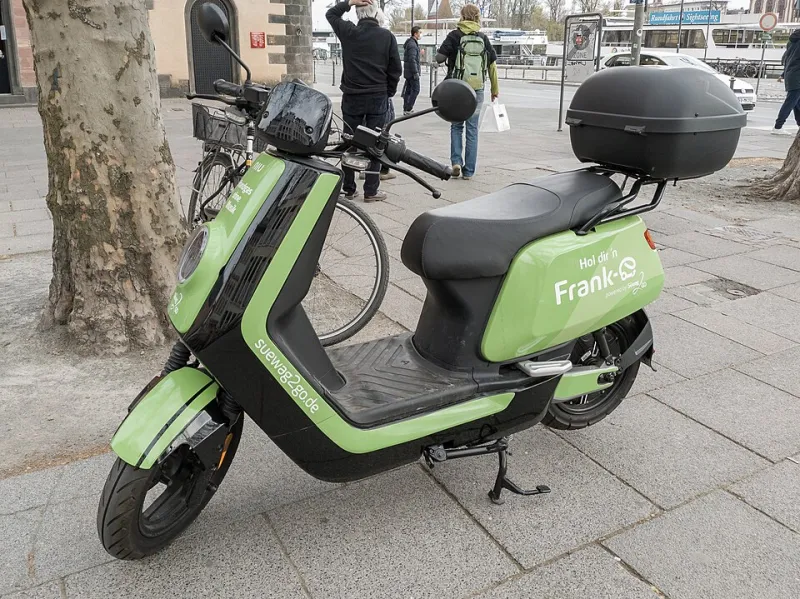
Photo: Matti Blume, CC BY-SA 4.0, via Wikimedia Commons
When a commuter in Austin, Texas, boards a dockless e-scooter to cover the last eight blocks to her office, she is engaging in what urban planners increasingly call a "first- and last-mile solution." When that same commuter travels to Nashville for work and tries to do the same thing, she may discover that the scooter she unlocks operates under an entirely different set of rules—different speed limits, different parking zones, different helmet requirements, and a different liability framework if something goes wrong. The device looks identical. The experience is not.
This is the central tension at the heart of American micromobility policy: a technology that moves freely across city lines is governed by regulations that stop hard at municipal borders.
A Nation of Local Experiments
The United States has no federal framework specifically governing shared micromobility devices. Regulation has been left almost entirely to cities and, in some cases, states—a situation that has produced a landscape of well-intentioned but deeply inconsistent policy.
San Francisco's approach is among the most structured in the country. The city's Municipal Transportation Agency operates a formal permit system that caps the number of operators allowed to deploy scooters, requires detailed ridership data reporting, and mandates equity commitments—including service in lower-income neighborhoods that private operators might otherwise ignore. Operators must reapply periodically and can lose their permits for noncompliance. The system is rigorous, but critics argue it has also slowed deployment and limited the number of devices available to riders during peak demand periods.
Miami has pursued a markedly different philosophy. City planners there have leaned toward integration, working to embed shared e-bikes and scooters into the broader transit ecosystem rather than treating them as a separate category to be contained. Miami-Dade Transit has explored data-sharing agreements with micromobility operators, and the city has invested in dedicated infrastructure—protected lanes and designated parking corrals—designed to make these devices feel like a natural extension of the transit network rather than an afterthought cluttering sidewalks.
Chicago, meanwhile, has taken a middle path, issuing permits but also conducting formal pilot programs that generate performance data before committing to long-term policy. The city's 2019 e-scooter pilot, which was later expanded, produced detailed ridership analytics that informed subsequent permit decisions. It is a methodical approach, but one that has also meant years of uncertainty for operators trying to plan their fleets.
The Rider's Reality
For the people actually using these devices to get to work, the regulatory inconsistency translates into a set of practical frustrations that are easy to underestimate from a policy distance.
Parking is among the most immediate pain points. In some cities, scooters must be returned to designated corrals—fixed physical locations that may or may not be near a rider's actual destination. In others, free-floating parking is permitted anywhere within a geofenced zone, provided the device is not blocking a curb cut or bus stop. Riders who commute across city boundaries—a common scenario in metropolitan areas like Dallas-Fort Worth or the greater Los Angeles basin—may find that the rules they internalized in one jurisdiction simply do not apply a mile down the road.
Helmet laws add another layer of complexity. Some states mandate helmets for all e-scooter riders; others require them only for minors; still others have no requirement at all. Operators have attempted to address this inconsistency through in-app reminders, but enforcement is effectively nonexistent, and the liability implications for riders involved in accidents differ substantially depending on where the incident occurs.
Speed and power restrictions vary as well. An e-bike classified as a Class 1 device in California—pedal-assist only, maximum 20 mph—may be treated as a Class 3 vehicle in another state, subject to different lane access rules and age restrictions. For riders who use these devices daily, understanding which classification applies in which context is an unreasonable cognitive burden.
The Operator's Dilemma
Shared micromobility companies occupy an uncomfortable position in this environment. Firms like Lime, Bird, and Spin must negotiate individual permit agreements with each city in which they operate, comply with data-reporting requirements that differ in format and frequency, and adjust their operational models—fleet size, parking enforcement protocols, pricing structures—to match local mandates.
The compliance overhead is not trivial. Smaller operators have struggled to absorb it, and several have exited markets or scaled back significantly in recent years. The consolidation that has followed may ultimately reduce competition and, with it, the downward pressure on pricing that benefits riders. It also concentrates market power in the hands of a small number of large platforms that can afford the regulatory burden—an outcome that sits uneasily with cities that positioned micromobility as a tool for equitable access.
Data sharing is a particular flashpoint. Many cities require operators to submit trip data through the Mobility Data Specification (MDS), an open standard developed by the Los Angeles Department of Transportation. But adoption of MDS has been uneven, and some operators have raised legitimate privacy concerns about the granularity of location data that certain implementations require. The result is a fragmented data landscape that makes regional transit planning significantly more difficult.
What a Unified Framework Might Require
Transportation researchers and advocacy organizations have increasingly called for some form of national baseline standards—not a federal takeover of micromobility regulation, but a set of minimum requirements that would ensure consistency on critical issues while preserving local flexibility.
Such a framework might establish uniform device classification standards, clarifying how e-bikes and e-scooters are categorized for purposes of speed limits, lane access, and age restrictions. It could standardize data-reporting formats, reducing the compliance burden on operators while ensuring that cities receive the information they need for planning. It might also address liability frameworks, providing clearer guidance on how responsibility is allocated among riders, operators, and municipalities when accidents occur.
The National Association of City Transportation Officials (NACTO) has published guidelines that move in this direction, and several metropolitan planning organizations have begun developing regional coordination mechanisms. Progress, however, has been slow. Local governments are understandably protective of their authority to manage public space, and the political economy of micromobility—which touches on sidewalk safety, neighborhood character, and commercial interests—makes consensus difficult to achieve.
The Cost of Inaction
The stakes are higher than they might appear. Micromobility is not a novelty. In many American cities, shared scooters and e-bikes are now a meaningful part of the daily transportation mix, particularly for commuters who live within two or three miles of a transit hub but face a gap that walking cannot practically bridge.
When regulation fails to keep pace with that reality—when parking rules are unclear, when liability is ambiguous, when operators are driven out of markets by compliance costs—the people most affected are not the policy analysts debating MDS standards. They are the workers who needed that scooter to make a bus connection on time.
Fixing the micromobility maze will require cities to do something that has historically proven difficult: coordinate with each other. The technology is ready. The riders are waiting. The policy infrastructure has not yet caught up.