Buying More to Carry Less: The Federal Incentives Behind America's Transit Fleet Expansion Paradox
In almost any other industry, declining demand triggers a contraction in supply. Companies reduce inventory, scale back production, and align their physical capacity with the number of customers they actually serve. American public transit, however, operates by a different logic—one shaped less by ridership data than by the mechanics of federal grant cycles, political visibility, and institutional incentives that reward acquisition over efficiency.
Between 2019 and 2023, dozens of major transit agencies across the country expanded their active vehicle fleets while simultaneously reporting sustained declines in boardings. The pattern is not incidental. It is, in many respects, the predictable outcome of how transit funding in the United States is structured at the federal level.
The Capital Bias Built Into Federal Grants
The Federal Transit Administration distributes billions of dollars annually through programs such as the Section 5307 Urbanized Area Formula Grants and the Section 5339 Bus and Bus Facilities program. These funding streams are specifically designated for capital expenditures—vehicles, infrastructure, and equipment—rather than for the operational costs of running service.
This distinction carries significant consequences. An agency facing a budget shortfall cannot use federal capital grants to pay drivers, cover fuel costs, or maintain existing service frequency. What it can do is apply those funds toward purchasing new buses, often at an 80 percent federal match that requires only a 20 percent local contribution. The result is a structural incentive to buy vehicles rather than operate them effectively.
For agency administrators navigating tight municipal budgets and political pressures, the arithmetic is difficult to ignore. A new bus purchase draws down federal dollars that would otherwise go unspent. It produces a tangible, photographable asset. It generates a ribbon-cutting moment. Operating subsidies, by contrast, are invisible to constituents and perpetually contested in local budget negotiations.
Use-It-Or-Lose-It Funding and the Procurement Treadmill
Federal transportation grants frequently operate on a use-it-or-lose-it basis. Agencies that fail to obligate funds within specified timeframes risk losing their allocations entirely—a prospect that creates pressure to identify and execute capital projects on an accelerated schedule, regardless of whether those projects reflect genuine operational need.
This dynamic places procurement staff in an uncomfortable position. The question is no longer simply whether a new vehicle is needed, but whether the agency can structure a purchase quickly enough to satisfy federal obligation deadlines. Fleet expansion becomes, in part, a financial management strategy rather than a service planning decision.
Several metropolitan transit authorities have acknowledged this tension in internal planning documents, noting that vehicle replacement schedules are sometimes accelerated not because existing buses have reached the end of their useful lives, but because grant timelines demand it. The buses arrive. The ridership does not follow.
Political Visibility and the Appeal of New Hardware
Beyond the mechanics of federal funding, there is a political dimension to fleet expansion that deserves direct examination. Elected officials and agency boards respond to constituent concerns about transit quality, and new buses—particularly those featuring modern amenities, low-floor boarding, or zero-emission powertrains—offer a credible signal of institutional investment.
In cities where ridership has declined, the political response is frequently to point toward fleet modernization as evidence of commitment to the system. This framing is not entirely disingenuous; newer vehicles do offer genuine improvements in accessibility and emissions performance. But it sidesteps a more uncomfortable question: whether additional capacity serves any meaningful purpose when existing vehicles are already running well below their passenger load targets.
The visibility of hardware purchases also tends to crowd out conversations about the operational and service-design changes that research consistently identifies as more effective at recovering ridership—improved frequency, better route alignment with actual travel patterns, and real-time information systems that reduce uncertainty for potential riders.
The Maintenance Burden That Follows
Every bus added to a fleet generates ongoing obligations that federal capital grants do not cover. Maintenance staffing, parts inventories, facility space, and insurance costs accumulate regardless of how frequently a vehicle actually enters service. For agencies already under financial strain, an expanding fleet can paradoxically worsen the budget conditions that led to service reductions in the first place.
This phenomenon—sometimes described by transit planners as the "maintenance debt" problem—is particularly acute for agencies that have accepted large numbers of zero-emission vehicles under grant programs tied to environmental mandates. Electric and hydrogen-powered buses carry significant upfront promise, but they also require specialized technician training, dedicated charging or fueling infrastructure, and parts supply chains that remain less mature than those supporting conventional diesel fleets. Agencies that expanded into these technologies faster than their operational capacity could accommodate have, in some cases, found themselves with vehicles sitting idle for extended periods awaiting parts or qualified service personnel.
Ridership Recovery Requires a Different Conversation
The evidence on what actually drives transit ridership recovery points consistently toward service quality rather than fleet size. Frequency matters more than vehicle newness. Network legibility—the ability of a potential rider to understand and trust how the system works—matters more than the age of the buses on a given route. Reliability, measured in on-time performance and schedule adherence, is among the strongest predictors of whether someone chooses transit over a personal vehicle.
None of these factors are primarily a function of how many buses an agency owns. They are functions of how service is designed, scheduled, and operated—areas where federal capital grants offer little direct support and where the political rewards for investment are considerably less immediate.
Several transit authorities have begun pushing back against this dynamic. The Southeastern Pennsylvania Transportation Authority, the Washington Metropolitan Area Transit Authority, and agencies in Denver and Salt Lake City have each, at various points, emphasized service restructuring and frequency improvements as central to their ridership recovery strategies. Some have worked with metropolitan planning organizations to redirect a portion of available federal funding toward technology investments—real-time scheduling systems, predictive maintenance platforms, and demand-responsive routing tools—that improve operational efficiency rather than simply adding to vehicle counts.
Aligning Incentives With Outcomes
The deeper problem is structural. As long as federal transit funding mechanisms treat capital acquisition as the primary measurable output of agency performance, the incentive to expand fleets during ridership declines will persist. Reforming that structure would require congressional action to create more flexible funding streams, along with performance metrics that weight ridership recovery and service utilization alongside vehicle procurement.
Some transit policy advocates have proposed tying a portion of federal formula grants to outcome-based measures—boardings per vehicle, cost per passenger mile, or service coverage relative to population density. Such approaches would not eliminate capital funding, but they would create a countervailing incentive that rewards agencies for deploying their existing fleets effectively before expanding them.
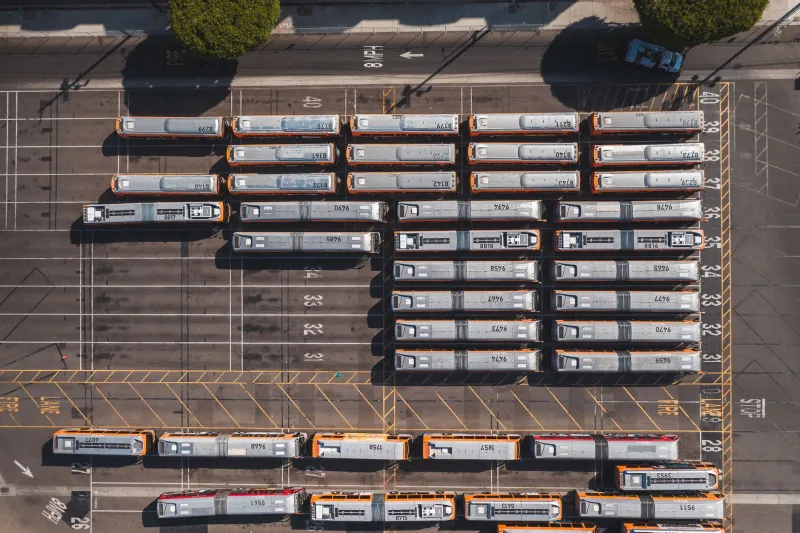
Until those structural changes materialize, American transit agencies will continue operating within a system that makes buying buses easier than running them well. The fleets will grow. The yards will fill. And the riders, for whom all of this hardware was ostensibly purchased, will continue making other choices.