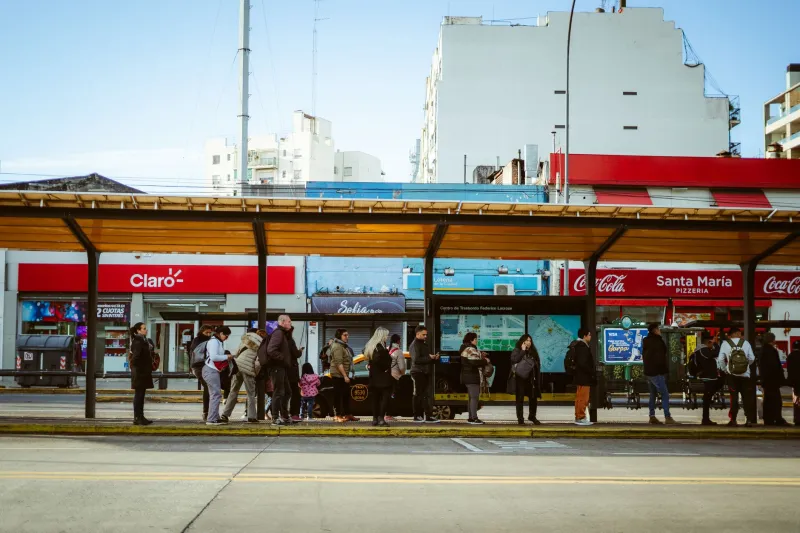
When the Bus Doesn't Show: How Transit Unreliability Shrinks the Job Market for Millions of American Workers

For most Americans with access to a car, a job listing twenty miles away is a manageable commute. For a worker dependent on public transit in a city like Memphis, Indianapolis, or even parts of Los Angeles, that same listing might as well be in another state. The obstacle is not always distance. Increasingly, it is time — and the profound uncertainty of not knowing whether the bus will arrive at all.
Transit reliability, long treated as an operational metric of interest mainly to agency planners, has a direct and measurable effect on where workers can seek employment. When service is unpredictable, the practical radius of a job search contracts. Workers absorb that constraint quietly, editing their ambitions to fit a system that was never designed around their schedules.
The Geography of Opportunity
Researchers at the Brookings Institution have documented a persistent gap in job accessibility between transit-dependent workers and those who drive. Across the fifty largest US metropolitan areas, the average worker can reach roughly 1.4 million jobs by car within a ninety-minute commute window. Transit-dependent workers in those same cities can reach fewer than 300,000 jobs within the same window — and that figure assumes the transit system operates as scheduled.
When reliability is factored in, the numbers deteriorate further. A 2022 analysis from the University of Minnesota's Accessibility Observatory found that in cities where buses run on time less than 70 percent of the time, effective job access for transit-dependent commuters drops by an additional 18 to 24 percent compared to what schedule-based calculations suggest. The jobs are theoretically reachable. In practice, they are not.
That gap carries a wage penalty. Workers who restrict their searches to employers within reliable transit reach — typically closer to city centers, along high-frequency corridors, or within walking distance of rail stations — tend to accept lower wages in exchange for commute certainty. A 2021 study published in the Journal of Urban Economics estimated that transit-dependent workers in unreliable service areas earned, on average, between 8 and 14 percent less than comparable workers in cities with higher service reliability, even after controlling for education, industry, and local cost of living.
The Hidden Calculus Workers Make
Talking to workers in cities with struggling transit systems, a consistent pattern emerges. The decision of where to apply for work is shaped not by ambition alone, but by a quiet risk assessment conducted before the job search even begins.
A home health aide in Detroit described turning down a higher-paying position at a facility in the suburbs because the connecting bus route ran only once per hour and was routinely late. "If I miss that bus, I lose the whole shift," she explained. "I can't afford to gamble on that." She took a lower-paying job two bus stops from her apartment instead.
A warehouse worker in Kansas City recounted a similar calculation. After spending three months applying broadly and losing two job offers because he arrived late to interviews — both times due to bus delays — he narrowed his search to employers within a single, more reliable corridor. "You learn pretty fast which routes you can trust," he said. "And then that's your world."
These individual decisions, multiplied across hundreds of thousands of workers in every major metro area, produce a measurable distortion in local labor markets. Employers outside reliable transit corridors struggle to attract workers without cars. Workers without cars accept lower wages to remain within reach of dependable service. Neither outcome is efficient. Both are largely invisible in standard economic reporting.
Extended Searches, Compounded Costs
Beyond wage suppression, transit unreliability extends the duration of job searches themselves — an outcome with its own economic consequences. A longer job search means more weeks without income, greater reliance on savings or public assistance, and reduced ability to weather the financial disruption of unemployment.
Data from the Bureau of Labor Statistics suggests that workers in metropolitan areas with lower transit reliability scores experience unemployment spells roughly 1.3 weeks longer on average than workers in high-reliability markets, controlling for local unemployment rates. That difference, modest in isolation, compounds across an entire workforce. For a city of one million transit-dependent workers, it represents tens of millions of lost workdays annually — a drag on productivity that no single employer or agency is accountable for producing.
The cost is borne almost entirely by the workers themselves. Unlike a delayed freight shipment or a supply chain disruption, the economic loss generated by an unreliable bus route does not appear on any balance sheet. It dissolves into the quiet decisions of individual workers adjusting their expectations downward.
What Better Data Could Change
The challenge is not simply one of funding more buses or expanding routes. Reliability requires operational discipline — consistent scheduling, real-time monitoring, responsive dispatch, and the kind of data infrastructure that allows agencies to identify and address chronic performance failures before they harden into permanent patterns.
Several US cities have begun deploying predictive analytics platforms that flag reliability failures in near real-time, allowing supervisors to intervene before a single delayed bus cascades into a disrupted corridor. Chicago's Transit Authority has piloted machine learning tools that predict bunching — the phenomenon where multiple buses arrive simultaneously after long gaps — and adjust signal timing to prevent it. Early results suggest meaningful improvements in on-time performance along corridors where the tools have been deployed.
Real-time data sharing between agencies and third-party navigation platforms has also shown promise. When riders receive accurate arrival information rather than optimistic schedule estimates, they can plan more effectively, reducing the penalty of unexpected delays. The information alone does not fix the underlying service problem, but it restores a degree of agency to workers who currently plan around uncertainty rather than around actual conditions.
Reliability as Economic Infrastructure
City planners and transit advocates have long argued that public transportation is economic infrastructure. The framing is correct but often incomplete. A transit network that exists on paper but fails in practice does not deliver the economic benefits its presence implies. A bus route that runs late 40 percent of the time does not connect workers to opportunity in any meaningful sense — it creates the illusion of access while quietly reinforcing the barriers it claims to dissolve.
For the workers adjusting their job searches, accepting lower wages, and building their professional lives around the geography of reliable service, this distinction is not abstract. It is the difference between a career that grows and one that stays exactly where it starts.
Fixing transit reliability will not solve every dimension of workforce inequality. But in city after city, the data points toward the same conclusion: when the bus shows up on time, workers go further. When it doesn't, they don't.