Tolls as Transit Funding: The Promise and the Politics of Congestion Pricing in American Cities
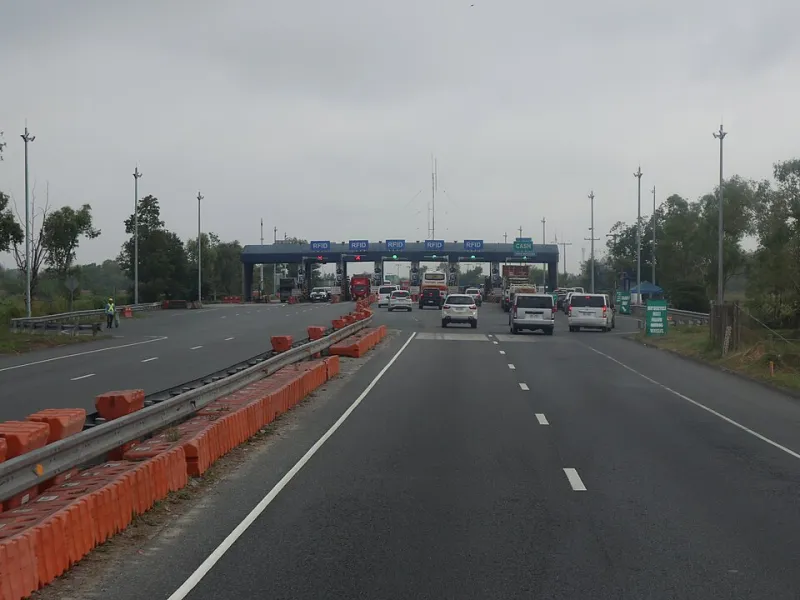
Photo: Patrickroque01, Public domain, via Wikimedia Commons
For decades, the idea of charging drivers a fee to enter a city's most congested corridors occupied a comfortable space in transportation policy literature: widely endorsed by economists, cautiously studied by planners, and reliably shelved by elected officials. That era of theoretical consensus is over. Congestion pricing has arrived in the United States, and the early results—alongside the fierce political resistance—offer a complicated picture of what this tool can and cannot accomplish.
What Congestion Pricing Is Actually Supposed to Do
At its core, congestion pricing operates on a straightforward premise: when driving into a dense urban core is free at the point of use, more people drive than the road network can efficiently accommodate. A toll introduces a cost signal that, in theory, encourages some drivers to shift to transit, adjust their travel times, or consolidate trips. The resulting reduction in vehicle volume moves traffic more efficiently for those who still drive, while the toll revenue is directed—in most program designs—toward funding public transportation improvements.
The mechanism matters because congestion pricing is frequently mischaracterized as simply a tax on commuters. Proponents argue it is more accurately described as a reallocation of road capacity, with the financial proceeds reinvested into the alternatives that make driving less necessary in the first place. The distinction is not merely semantic; it determines whether the policy functions as a transit investment strategy or as a revenue extraction exercise.
London and Singapore: What the Data Actually Shows
The two most-studied congestion pricing programs in operation—London's Central London Congestion Charge, launched in 2003, and Singapore's Electronic Road Pricing system, which has been in continuous evolution since 1975—offer instructive but imperfect precedents for American cities.
London saw an approximately 30 percent reduction in traffic volumes within the charging zone in the years following implementation, along with measurable improvements in bus journey times. Transport for London reported that net revenues were directed toward bus network enhancements, contributing to increased ridership through the mid-2000s. However, subsequent expansions of the zone proved politically contentious, and critics noted that the congestion benefits eroded over time as the city's population and commercial activity grew around the charging boundary.
Singapore's approach, which uses dynamic pricing that adjusts toll rates based on real-time traffic conditions, is widely regarded as the more technically sophisticated model. The city-state's integrated land use planning and its high-quality Mass Rapid Transit network provide a baseline that few American cities can replicate. Analysts who study Singapore's outcomes frequently caution against direct comparisons to US metro areas, where transit alternatives are often insufficient to absorb displaced drivers.
That gap between the international evidence and American urban conditions is precisely where congestion pricing debates tend to break down.
New York's Contested Experiment
New York City's congestion pricing program—targeting vehicles entering Manhattan south of 60th Street—represents the most significant American test of the model to date. The program was designed to generate dedicated funding for the Metropolitan Transportation Authority, with projections indicating billions of dollars in capital investment capacity for subway, bus, and commuter rail improvements.
The political trajectory of the program has been turbulent. After years of legislative negotiation and federal environmental review, implementation was paused by the state's governor in 2024, citing economic concerns related to the post-pandemic recovery of Midtown Manhattan businesses. The pause drew immediate legal challenges from transit advocates and raised fundamental questions about the durability of congestion pricing programs when they encounter electoral pressure.
The New York episode illustrates a structural vulnerability that urban mobility planners must account for: congestion pricing programs require a sustained political commitment that often outlasts the administrations that design them. When economic conditions shift or business interests mobilize, the programs become targets regardless of their transportation merits.
The Equity Problem That Won't Go Away
No honest analysis of congestion pricing can sidestep the equity dimension. Critics across the political spectrum have raised concerns that flat or insufficiently graduated toll structures impose a disproportionate burden on lower-income workers who have no viable transit alternative and cannot afford to live near the urban core.
These concerns are legitimate and empirically grounded. In cities where transit networks are incomplete, infrequent, or unreliable, a congestion charge does not present all drivers with an equivalent choice. A worker commuting from a transit-poor suburb to a downtown job faces a different calculus than a professional who lives two blocks from a subway station. If the toll revenue is not reinvested quickly enough to improve those transit alternatives, the program effectively taxes the mobility of people who have the fewest options.
Some program designs attempt to address this through income-based exemptions, credits, or reduced rates for low-income drivers. New York's program included provisions for low-income tax credits. Whether such mechanisms are sufficiently calibrated to offset the regressive elements of a flat toll remains a matter of active debate among transportation economists.
City planners interviewed by transit policy researchers have noted that the sequencing problem is particularly acute: the transit improvements that would make congestion pricing equitable often depend on the revenue that the pricing program is supposed to generate. The chicken-and-egg dynamic requires either significant upfront public investment in transit capacity or a willingness to accept a transitional period during which lower-income commuters bear a disproportionate cost.
Revenue Allocation: The Critical Variable
Perhaps the most important determinant of whether congestion pricing delivers on its transit promise is not the toll structure itself but the legal and institutional mechanisms governing how revenue is spent. Programs that direct funds into a dedicated transit capital account with strong legislative protections have a meaningfully different track record than those where revenue flows into general municipal budgets subject to annual appropriations battles.
Transportation finance specialists consistently identify revenue ring-fencing as the variable that separates programs that produce transit improvements from those that produce only traffic redistribution. When toll revenue competes with other budget priorities, the transit investment rationale for the program weakens, and the political case for maintaining the toll in the face of driver opposition becomes correspondingly harder to sustain.
A Tool, Not a Solution
Congestion pricing is neither the transformative transit funding mechanism its most enthusiastic advocates describe nor the regressive commuter penalty its sharpest critics portray. It is a policy instrument whose outcomes depend heavily on implementation details, institutional context, and the quality of the transit network that surrounds it.
For American cities considering the approach, the international evidence suggests several conditions that improve the likelihood of meaningful transit benefit: a transit network robust enough to absorb displaced drivers, revenue protections that insulate transit investment from political reallocation, equity provisions calibrated to actual commuter hardship rather than political optics, and the institutional staying power to maintain the program through the inevitable periods of backlash.
What the evidence does not support is the assumption that a toll alone fixes a transit system. The toll creates a revenue stream and a traffic signal. What cities build with that signal—and that revenue—determines whether congestion pricing is a genuine transit investment or an expensive lesson in the limits of pricing policy.